A Reunion Eighty Years in the Making
When the world’s great tall ships gather for Sail250, spectators will see towering masts, gleaming brass, and acres of canvas stretching across the horizon. But hidden beneath the beauty is one of the most remarkable stories in maritime history.
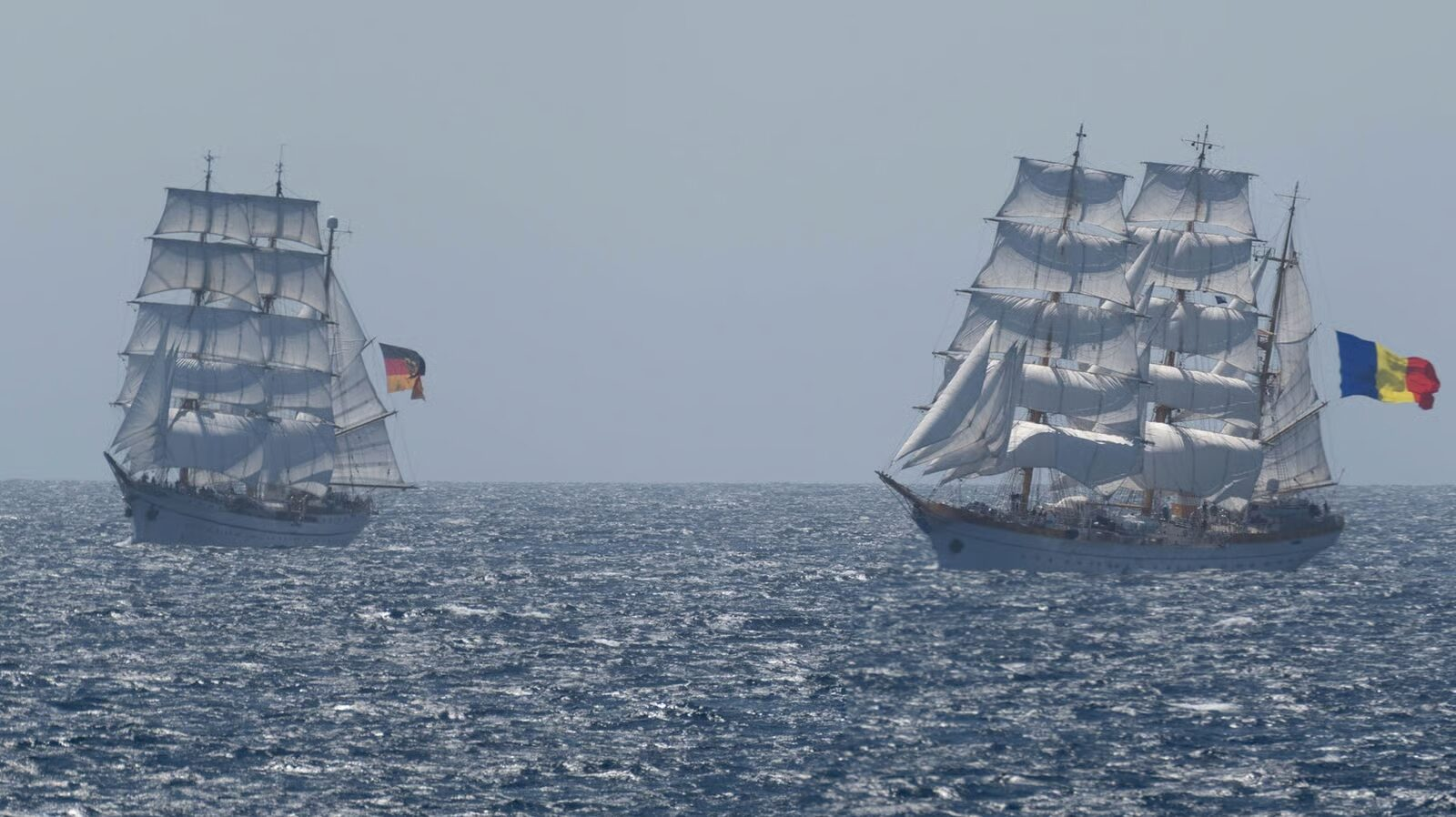
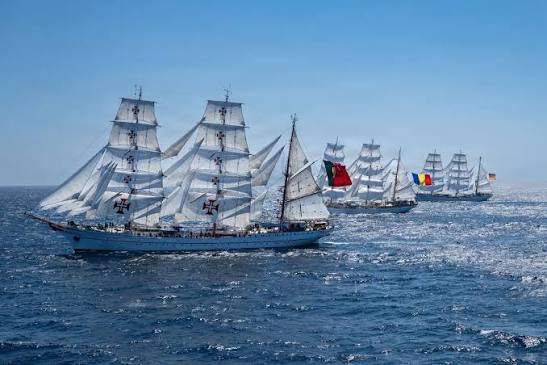
Four nearly identical ships—now sailing under four different flags—were once sisters, built side by side in Germany before World War II. They survived hurricanes, mines, political upheaval, and the devastation of global conflict before finding new homes around the world.
Their reunion during Sail250 is far more than a parade of historic vessels. It’s a living reminder that even ships shaped by war can become symbols of friendship, education, and international cooperation.
“But in a gale, the silent machinery of a sailing-ship would catch not only the power, but the wild and exulting voice of the world’s soul.” —
Joseph Conrad, The Mirror of the Sea
The American Sister: USCGC Eagle
Perhaps the most recognizable of the fleet to American audiences is the USCGC Eagle, the official training ship of the U.S. Coast Guard Academy.
Originally launched in 1936 as the Horst Wessel, the vessel was awarded to the United States as war reparations after World War II. Since arriving in New London, Connecticut, in 1946, she has trained generations of Coast Guard officers and become affectionately known as “America’s Tall Ship.”
Her resilience is legendary.
During a North Atlantic training cruise in 1953, Eagle encountered a Category 3 hurricane that shredded her sails and disabled her engine. To survive, her captain ordered the remaining storm sails rigged in reverse, allowing the vessel to sail backward into the wind for nearly three days while keeping her bow pointed toward the towering seas. Though the ship’s ballast shifted under the tremendous strain, the nearly two-decade-old hull endured, cementing her reputation as one of the toughest sailing ships ever built.
Portugal’s Survivor: NRP Sagres
Portugal’s beloved training ship, NRP Sagres, has lived several lives.
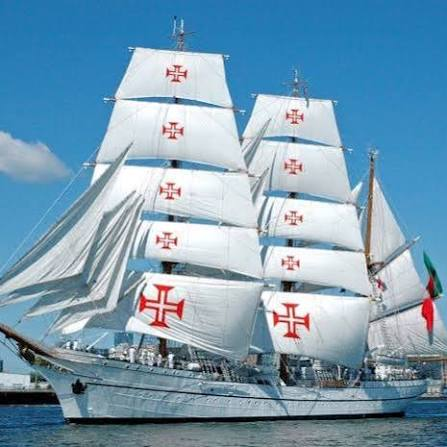
Launched in 1937 as the Albert Leo Schlageter, she later sailed for Brazil before joining the Portuguese Navy in 1961. Today, her striking white sails adorned with the red Cross of Christ make her one of the most recognizable tall ships in the world.
Her most dramatic chapter came during World War II.
While operating in the Baltic Sea in 1944, the ship struck a Soviet naval mine. The explosion tore open her hull and claimed the lives of several crew members. Somehow, the crew managed to beach the vessel before she sank completely, saving both the ship and many aboard. Repaired and eventually transferred after the war, she continues sailing today—still bearing subtle structural reinforcements that quietly testify to the blast she survived.
At SAil250, NRP Sagres sailed precious cargo in her hull – cases of 1776 Portugese Madiera wine to toast the birthday celebration.
Romania’s National Treasure: NMS Mircea
Unlike her sisters, NMS Mircea has spent nearly her entire life under the Romanian flag.
Launched in 1938 and named after the medieval ruler Mircea the Elder, she remains the closest example of the original design created by the famed Blohm & Voss shipyard.
During World War II, Romanian commanders feared Soviet aircraft would destroy the vessel, so they stripped much of her rigging, camouflaged her with branches and netting, and concealed her deep within the Danube River.
After Romania changed sides in 1944, Soviet forces seized the ship anyway.
For more than a year, Romanian diplomats fought to bring Mircea home. When she finally returned to Constanța in 1946, thousands gathered along the waterfront to welcome her back. For many Romanians, the ship represented more than steel and timber—it represented their national identity.
Germany’s New Beginning: Gorch Fock
Germany’s representative at Sail250 tells a slightly different story.
The current Gorch Fock, launched in 1958, is not one of the original pre-war sisters. Instead, she was built after World War II using the exact original blueprints.
Germany had lost its entire sail-training fleet through wartime reparations. When the newly formed Federal Navy sought to rebuild traditional seamanship in the 1950s, naval architects returned to the original 1930s plans and recreated the famous vessel almost bolt for bolt.
Today’s Gorch Fock honors the legacy of the original ship while carrying it into a new era of international friendship.
The Sister That Never Sailed
There was supposed to be a fifth original sister.
Herbert Norkus, laid down in 1939, was never completed.
As World War II intensified, resources shifted away from shipbuilding toward submarines and military production. Allied bombing further damaged the unfinished hull, and after the war she was filled with unexploded munitions and deliberately scuttled in the Skagerrak Strait in 1947.
Her loss makes the survival of the remaining sisters even more extraordinary.
The Sisterly Tradition
Among tall ship crews, traditions run deep.
Whenever two of these sister ships meet at sea, they often do more than exchange horn blasts. Sailors climb into the rigging—known as manning the yards—and greet one another with sea shanties echoing across the water.
It’s a gesture that acknowledges not only shared design but shared history.
Despite sailing under different nations, their crews understand they are custodians of the same remarkable legacy.
A Once-in-a-Lifetime Reunion
Out of the five original sister ships planned before World War II, four survived in one form or another. Few classes of historic ships can claim such an extraordinary survival rate after enduring combat, mine strikes, bombardment, political upheaval, and nearly ninety years at sea.
Their gathering during Sail250 is more than a maritime celebration.
It is a reunion of vessels that once sailed through one of history’s darkest chapters and now return as ambassadors of peace, education, and international goodwill.
For visitors lining the waterfront, they’ll simply see magnificent tall ships under full sail.
For those who know their history, they’ll witness one of the rarest and most meaningful reunions ever to grace the sea.
Nearly ninety years after the first sister slipped into the Elbe, Blohm & Voss’s craftsmanship is still crossing oceans. Four of the original pre-war hulls—or their direct descendants—continue to sail the world, their steel frames having survived hurricanes, mine explosions, political upheaval, and generations of cadets learning the timeless art of seamanship.
The Shipyard That Built Legends
The Blohm & Voss engineers who designed the original Gorch Fock-class created one of the most successful sail-training ships ever built. Their design proved so seaworthy that four original pre-war hulls survived World War II, crossed oceans under multiple flags, and remain active nearly ninety years later.
That longevity is virtually unmatched in naval history.
Long before the Eagle, Sagres, Mircea, and Gorch Fock became ambassadors of goodwill, they were simply ambitious engineering projects taking shape along the busy waterfront of Hamburg, Germany.
Their birthplace was Blohm & Voss, one of the world’s most respected shipyards.
Founded in 1877 on the banks of the River Elbe, Blohm & Voss had already earned an international reputation for building magnificent ocean liners, merchant ships, and naval vessels. By the early 1930s, its craftsmen were among the finest shipbuilders in Europe, blending centuries of maritime tradition with modern steel construction.
After World War I, the German Navy faced an unexpected challenge. Steam engines and machinery could power ships, but they couldn’t teach judgment, discipline, or leadership. Naval officers believed the best sailors were still made under sail, where every gust of wind demanded teamwork and every mistake carried real consequences.
Blohm & Voss was tasked with designing a new generation of sail-training ships—vessels that honored the traditions of the Age of Sail while embracing the safety and strength of modern engineering.
The result was extraordinary.
Beginning with Gorch Fock in 1933, the yard produced a class of elegant three-masted steel barques that quickly became renowned for their balance, speed, and forgiving handling. Over the next six years came Horst Wessel, Albert Leo Schlageter, Mircea, and finally Herbert Norkus, the unfinished fifth sister.
No one could have imagined how dramatically their futures would diverge.
As Europe marched toward war, so did Blohm & Voss.
The graceful training ships gave way to grim necessities. The shipyard became one of Nazi Germany’s largest naval construction centers, turning out submarines, destroyers, cruisers, and other warships at an astonishing pace. Steel and skilled labor that once built majestic sailing vessels were redirected toward weapons of war, and construction on the fifth sister, Herbert Norkus, slowed to a halt. She would never be completed.
The war soon reached Hamburg itself.
Because Blohm & Voss had become so vital to Germany’s military, it became a prime target for Allied bombing. Massive air raids devastated the city, leaving much of the shipyard in ruins. During these years, the company also relied heavily on forced laborers brought from occupied Europe—a painful chapter that remains inseparable from its history.
When Germany surrendered in 1945, it seemed as though the era of these remarkable sailing ships had come to an end.
Instead, it was only the beginning of a new story.
The victorious Allies divided Germany’s sail-training fleet as war reparations. One ship sailed west to become America’s USCGC Eagle. Another eventually found a new home in Portugal as Sagres. Romania reclaimed Mircea, while the original Gorch Fock, after being scuttled and later salvaged by the Soviet Union, embarked on yet another remarkable life before eventually becoming a museum ship.
Then came an unexpected twist.
When West Germany rebuilt its navy in the 1950s, officials searched through dusty archives at Blohm & Voss and uncovered the original blueprints from the 1930s. Rather than create a new design, they chose to recreate the beloved ship almost exactly as she had been built before the war.
The modern Gorch Fock, launched in 1958, carries forward that remarkable lineage.