

Top
Image Alt

Going Coastal

Coastal Commons

Morning light, liquid gold, spills across the marble façade of Teatro La Fenice—phoenix of opera houses, reborn from fire as memory rises from loss. We step inside a Fabergé egg of pink and lime, unfolding from the Royal Box onto an intimate stage, where a baroque clock fixed in the ceiling presides over the orchestra pit. Today, Alban Berg’s Wozzeck is in rehearsal; we are treated to song, music, and stage directions. The theater hosts an exhibit on Maria Callas, who debuted here in 1947, just twenty-four, in Wagner’s Tristan und Isolde. A bridge behind La Fenice is dedicated to the Divina.  

Here Ruskin’s wife Effie Grey found common ground with John, she was a theater lover but hated opera – “We hear the Italians are mad for opera, but I cannot bear the shrieking. Give me a quiet play or a puppet show any day.” Ruskin loved “Venice by moonlight, the canals, the palaces—but the theater I left to the tourists. I had work to do on stone and water, not on painted scenes.” “I avoid the opera house—the Fenice is a gaudy shell, and the music within is worse than the decoration.” He saw it from the outside, criticized it, and kept walking.

Proust, on the other hand, was passionate about opera and attended evening gatherings with music, including Italian arias. He wrote to friends about Venetian “serenades” and operatic songs echoing on canals. Marcel Proust’s Venice was a city of Ruskin’s stones but also operatic memory—“but no Wagner,” he wrote; “his music would drown the canals.”

Teatro La Fenice that season might have offered Aida, Otello, and La bohèmeItalian bel canto only. Wagner died in Venice in 1883 at the Palazzo Vendramin-Calergi (now the Casino di Venezia), murmuring “I am content” in Cosima’s arms and praising the city as a dream where he could “breathe freely,” Proust encountered none of his music here. In its place, the canal echoed a gondolier’s melancholy song, “O sole mio”; the melody lingered like the taste of madeleines, a summons from loneliness to his mother, propelling Marcel to rush to the train.

From here, the walk to Museo Fortuny is an ascent into the texture of Venetian creativity. The Palazzo Pesaro degli Orfei, a 15th-century Gothic residence, feels like a memory suspended in amber. The genius of Mariano Fortuny y Madrazo, a Spanish polymath—artist, inventor, and fashion designer—who opened his couture house here in 1906, weaving his magic until 1946. After Fortuny’s death, his wife and collaborator, Henriette Negrin left the palace to Venice, in 1975 it became a museum and in 2022 was transformed into this lush Fortuny palace by designer Pier Luigi Pizzi.  The brand exists to this day with shops in Venice, Paris, and the fabric works on Giudecca. 

Marcel Proust’s connection to Mariano Fortuny—mediated through his intimate friend Reynaldo Hahn, who introduced him to Fortuny’s mother Cecilia—bridges art, fashion, and Venice’s evocative aura. The designer’s luxurious fabrics and gowns are the only real creations by a named artist in In Search of Lost Time. Marcel’s devotion to these gowns feels almost tangible. “What I liked at the moment was all Fortuny did.” Worn by the Duchesse de Guermantes and Albertine, Fortuny’s pleated silks evoke the folds of time itself, like Proust’s metaphoric “fabric of memory” whose threads are sensation and recollection. We read aloud passages from the book:

The Fortuny dress that Albertine wore that evening seemed to me like the tempting shadow of this invisible Venice. It was invaded by Arabic ornamentation like Venice, like the palaces of Venice hidden in the manner of the sultanas behind an openwork veil of stone, like the bindings of the Ambrosian library, like the columns of which the oriental birds that alternately mean death and life, repeated in the shimmer of the fabric, of a deep blue that as my gaze advanced it changed into malleable gold, by these same transmutations which, in front of the gondola that advances, change into metal flaming metal the azure of the Grand Canal. And the sleeves were lined with a cherry pink that is so particularly Venetian that it is called Tiepolo pink.”

A traghetto from Fondaco Marcello to San Tomà ferries us across the canal. Venice offers no distance between art and life, past and present. Even a traghetto ride becomes an act of remembering.

Lunch is an informal reunion with an old college friend, fellow wanderer from our youth. Marcel’s meditations on aging hold profound truth—people we have known young remain forever young. Over plates of Venetian vongole, conversation turns to how both Ruskin and Proust eyed Venice—as a ceaseless dialogue of waves and stone, the real and the remembered. As Venice inspired Proust to weave personal epiphanies into universal meditations on art’s power to reclaim the past, we in turn, are cementing the city’s role as a shimmering manuscript of our own memories.

The afternoon’s persistent question: What did we gain from reading Proust slowly, deliberately? Proust, philosophy’s quiet sage of joy, turns every page into a lamp that lights our way toward understanding. We are beholden to Harold Bloom, who said: “It is wisdom literature. Aesthetic salvation is the enterprise of his vast novel…”

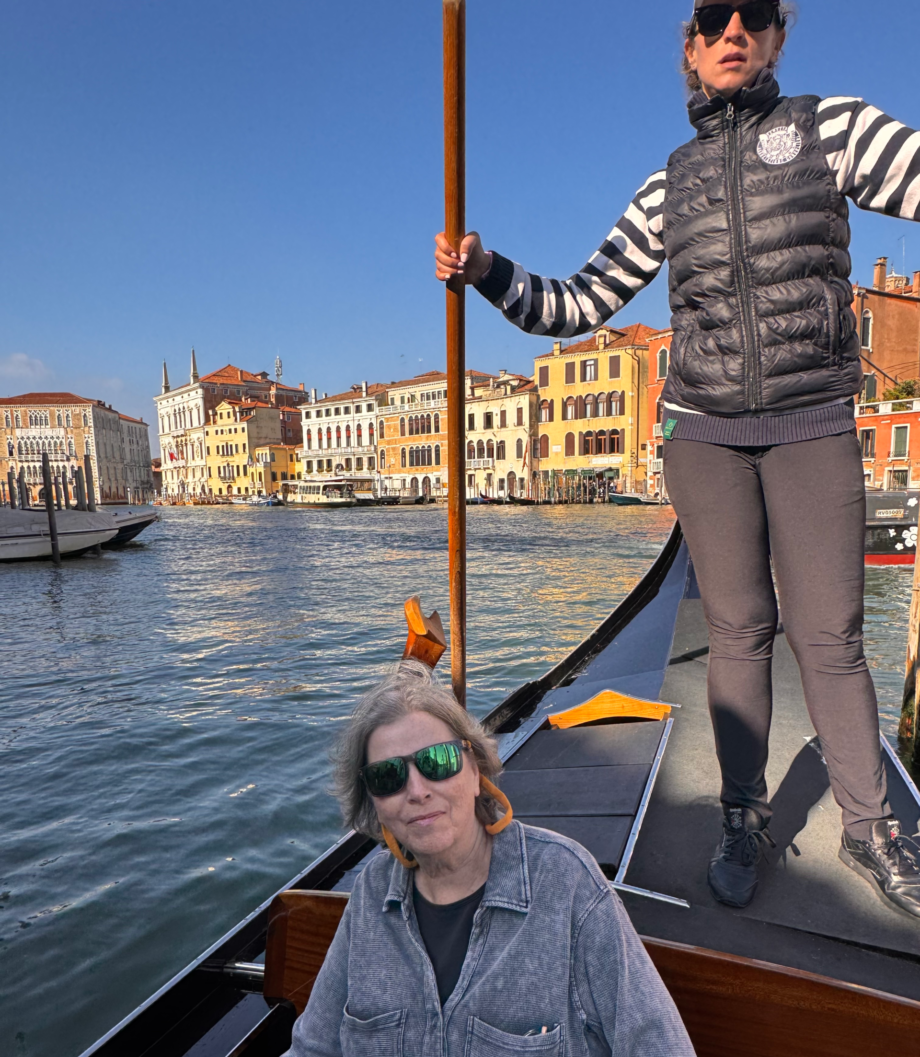
We, happy crew, push off from Ca’d’Oro in a vaporetto up the Grand Canal, much like Proust’s gondola in his reverie, “we watched the double line of palaces between which we passed reflect the light and angle of the sun upon their rosy surfaces, and alter with them, seeming not so much private habitations and historic buildings as a chain of marble cliffs at the foot of which people go out in the evening in a boat to watch the sunset.”

These noble piles of stone that so captivated Ruskin’s heart and mind. Ruskin sketched and studied the Ca’ d’Oro obsessively, calling it one of the “purest and most noble” examples of Gothic in the city. We analyze time and place as Ruskin had, taking tape measure to a Gothic facade, eyeballing a Byzantine window, tracing a Renaissance accent. In passing, we point out Fondaco dei Tedeschi scraped of Giorgione’s famous frescos (fragments are in the Accademia) that reminded Marcel of Putbus’ maid, the old Hotel Europa (Palazzo Ca’Guistiani) where Proust dangled his elbow over the balacony, Palazzo Contarini Fasan – the mythical house of Desdemona, and other landmarks to the Giardini. 

As dusk gathered, we settle for aperitivo and sunset at a bar gazing across the Riva degli Schiavoni. The Titian red sky slowly fades to Tiepolo pink casting a fiery glow over the figure of San Giorgio Maggiore.

Later, we return to Caffè Florian—a Ruskin haunt Proust knew well—where fictional Bloch, In the Shadow of Young Girls in Flower boasts of his Venetian escapade: “to drink sorbets with lovely ladies while pretending to read The Stones of Veneece,” dismissing Ruskin as “one of the most crashing bores there have ever been.”

We turn the pages of The Stones of Venice, listening to the band. Here, we are at Café Florian, dipping a humble Venetian Esse biscuit into thick hot chocolate, chasing the same quiet miracle as Proust’s legendery madeleine: one swirl, one bite, the past leans in to whisper.

GOING COASTAL ESSENTIALS