

Day 6: Venice and the Art of Patient Looking
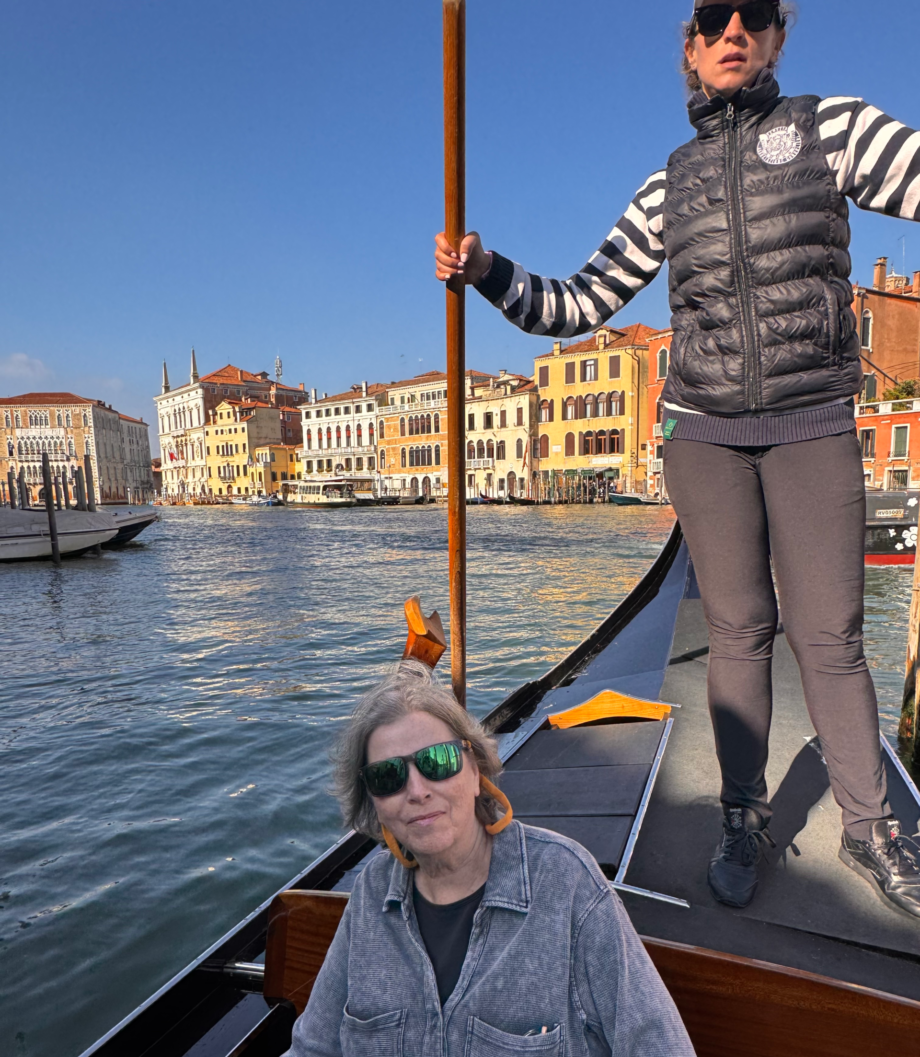
Proust described the experience of waking to the play of light on the water and the sound of gondoliers calling below. Hahn, too, recalled these days with great tenderness; afternoons spent sketching music, reading Ruskin aloud, and gliding through the canals in a gondola, lost in quiet conversation. Ruskin’s words return—“The greatest thing a human soul ever does is to see something, and tell what it saw in a plain way”—while the city answers with its own quiet eloquence, offering a morning shaped not by clocks but by light, water, and the slow unfolding of craft.
Today’s journey began with an exclusive tour of Tessitura Luigi Bevilacqua, an historic workshop where luxury Venetian silk and velvet textiles continue to be crafted entirely by hand. The ancient looms operate with a deliberate, rhythmic creak as velvet is produced, emerging strand by strand in a process akin to weaving light and shadow itself. In 1499, the Venetian painting The Capture of St. Mark in the Synagogue depicted noble weaver Giacomo Bevilacqua among its patrons. Centuries later, in 1875, Luigi Bevilacqua revived the family’s textile tradition by restoring 18 original looms from Venice’s renowned Silk Guild. Today, the tessitura remains under the stewardship of Luigi Bevilacqua’s children and heirs. Here, John Ruskin’s concept of “joy in labor” is palpably evident, while Marcel Proust’s metaphor of memory as a woven fabric takes on a dramatically literal dimension.
Every view of a Venetian Renaissance masterpiece by Bellini, Titian, or Carpaccio is a direct gaze into the opulent world of Bevilacqua textiles, where the silks, velvets, and brocades—woven by the Bevilacqua family since the 15th century—that drape saints, doges, and merchants were woven on the very looms still preserved at Tessitura Luigi Bevilacqua.
A short walk brought us to San Giacomo dell’Orio, one of Venice’s oldest churches, founded in the 9th century and rebuilt in the 13th. It stands in a lively campo, one of Venice’s most inviting squares, shaded by trees where locals gather and children play. Cafés dot the perimeter, giving a warm neighborhood feeling far from tourist crowds. The church’s exterior is simple and irregular, but inside, its “ship’s-keel” wooden ceiling—a carved and painted timber roof resembling the hull of a ship, blends Venice’s maritime heritage with beauty born of human imperfection. The slightly asymmetrical columns, praised by Ruskin and others, add to this unique charm.
Sunlight filters softly across the painted wooden beams and the exquisite Renaissance masterpieces inside. Lorenzo Lotto’s altarpiece “Virgin Mary and Child with Apostles and Saints” graces the main altar, while Paolo Veronese’s decorative ceiling paintings enrich the sacristy, adding vibrant color and life. Dust motes drift in the light, lingering like memories, making San Giacomo dell’Orio a perfect place to experience both Venetian art and everyday life in this historic neighborhood.
Crossing bridges, we step into the world’s first Jewish Ghetto, established in 1516, confining some 700 Jews to a cramped, canal-ringed island in Cannaregio where gates locked nightly and yellow badges marked their movements, yet allowing them to practice their faith and lend money vital to the Republic’s trade. On the Campo del Ghetto Nuovo, a temporary sukkah with its thatched roof—erected for the autumn festival of Sukkot to evoke the Israelites’ desert wanderings—stands amid the frayed square.
Our hour-long guided tour unlocked the discreet wooden doors of two of the ghetto’s five historic synagogues—hidden atop buildings known only by five arched windows representing the five books of the Torah—including the Scuola Levantina and Scuola Italiana, which was founded by exiled Jews from the Papal States in the 1400s and traces its roots to ancient Roman Jewish rites. Only two remain in active use today, the Spanish Synagogue air-cooled for humid summers and the Levantine heated against winters cold, while the two Ashkenazi Scuola Grande Tedesca (Great German Synagogue), Baroque Scoula Canton and the Sephardic Scuola Spagnola host tours revealing artifacts like embroidered velvet Torah covers and illuminated manuscripts. Tenement-style facades, some rising eight low-beamed stories on Venice’s unstable pilings, testify to a population that swelled to over 3,000 by the 17th century, forbidden to expand outward and forced upward in vertical exile.
The paradox of the ‘New’ Ghetto (Ghetto Nuovo) being older than the ‘Old’ (Ghetto Vecchio) is a poetic reminder of Venice’s layered history, where time folds back on itself in unexpected ways. The Canneregio sestiere is just beyond the areas Ruskin explored, no architectural grandeur in these quarters. A Protestant Victorian, the art critic had argued against Britain granting Jews civil and political rights on grounds it would undermine Christian societal structure. Proust, on the other hand, understood the veiled architectures of memory and society, where the visible world conceals invisible inheritances; born to a Jewish mother who never converted and a Catholic father, Proust was baptized yet remained rabbinically Jewish, his intimate bond with his mother infusing his work with the poignant duality.
In the quiet embrace of Madonna dell’Orto, a 14th-century Gothic edifice with an ornate façade touched by the early Renaissance. It was Jacopo Tintoretto’s lifelong parish and now holds his tomb. Inside, eleven of his paintings animate the nave and apse—dramatic canvases such as the Presentation of the Virgin, the Last Judgment, the Adoration of the Golden Calf, and the Vision of Saint Peter—full of bold light, deep shadows, and the artist’s intense faith, created between 1550 and 1575 for his “house of God.” In the right chapel lies his simple white stone tomb, marked for him, his wife Faustina, and their children—a humble spot under the soaring arches that speaks of life’s end in a place where art is eternal. A reproduction stands in for Bellini’s serene Madonna and Child—stolen from the Valier Chapel in 1993 and never recovered.
John Ruskin loved Venice’s fading beauty and called the church “an interesting example of Renaissance Gothic, the traceries of the windows being very rich and quaint.” He was especially moved by Tintoretto’s powerful altarpieces, seeing them as signs of the city’s lively spirit amid encroaching ruin. And so, like the Gothic steeple in Proust’s Combray—which rises not as dead stone but as a living arrow shot from time’s relentless bow, summoning lost afternoons in a single involuntary memory—this church endures not merely as masonry or tomb, but as a spark to the soul, worn yet rekindling the artist’s belief in the eternal reach of art.
Cannaregio was the world that nurtured two of Venice’s greatest painters—Paolo Veronese and Jacopo Robusti, better known as Tintoretto. Fondamenta dei Mori, a tranquil canal-side walkway, was both the birthplace and lifelong home of Tintoretto. Born in 1519 to Giovanni Robusti, a silk dyer whose trade is still echoed in the building’s Gothic façade with its carved shuttles and bolts, Tintoretto lived here surrounded by the rhythms of his father’s dye vats. He raised eight children in this very house and remained until his death in 1594 at the age of 75. Later in life, Veronese lived just next door, two giants of Venetian art united by neighborhood and history.
The house’s façade carries a Latin inscription—“Ne tentes aut perfice,” meaning “Either do not attempt, or complete” (all or nothing)—a motto that perfectly encapsulates the passionate ambition behind the fiery, luminous strokes that would adorn half of Venice’s churches. At Campo dei Mori the statues of turbaned “Moors” set into the walls of the Palazzo Mastelli, depict three spice merchant brothers—Rioba, Sandi, and Afani—who settled in Venice in the 12th century after fleeing the Peloponnese, known then as Morea. According to local lore, they were cursed and turned to stone by Santa Maria Maddalena after defrauding a devout Venetian woman, serving as a timeless warning against greed. We stop to rub the iron nose of the most famous statue, Sior Antonio Rioba, to bring good luck.
As we make our way back to the hotel, the evening light turned amber reflected in the ripples along the canal. We pass shuttered shop windows and the air smells of receding tide, aware that in the morning we would be leaving. There was no grand farewell—just the steady sense of a place folding back into itself, content to remain exactly as it had been before we arrived.
“But each of the days gone by has remained deposited in us, like in an immense library where there is a copy of the oldest books that no one, probably, will ever request.” – ” Time Regained by Marcel Proust