

Day 2: Venice Reflected: Ruskin, Proust, and the Soul of St. Marks
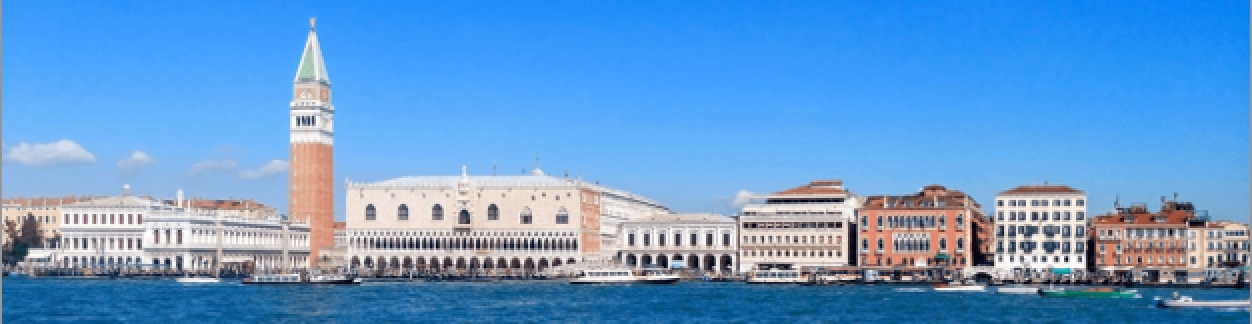
Morning light gilds Piazza San Marco like a shallow sea, pigeons fluttering as musical notes. Everywhere St. Marks’ winged lion holds out his book, with its message “Pax Tibi Marce Evangelista Meus” (Peace be with thee, O Mark, my evangelist), the words uttered by an angel to Mark in a dream, the coat of arms of the Republic of Venice, the city’s patron saint.
We stood before St. Mark’s Basilica, just as John Ruskin once did, reverent, breath held. In The Stones of Venice, he called the façade “a city in stone” — layers of Byzantine splendor and Venetian pride, where every mosaic and column are both ornament and history. Proust, too, approached it as a revelation, notebook in hand. The basilica’s ornate surfaces, like memory itself, shimmered with a meaning that shifted as you moved — a phenomenon Proust would later liken to the layered experience of love and loss.
The ancient mosaic above the Porta di Sant’ Alipio of St. Mark’s Basilica, dating to the 11th century, portrays a procession before the unaltered Basilica, serving as a mnemonic device for the entire structure—mirroring the vivid impression it left on Proust, a basilica embedded within a basilica, encapsulating preserved memory.
Inside, the “Golden Church” opens like a treasure chest. Over 8,000 square meters of mosaics envelop you in a radiant dusk. Ruskin would have insisted you look up — at the five domes that map the lives of the prophets, saints, affirming the city’s divine right to Mark’s relics and legitimizing the Doge’s political authority — and then look closer, at the tesserae that reveal the hands of craftsmen long dead but vividly present. At the Pala d’Oro, the sacred meets the sumptuous: gold, enamel, gems — the glory of God, but also of a mercantile empire.
The nave lights came on at 11:30 AM for an hour, allowing us to trace the atrium’s Old Testament mosaics a “poor man’s Bible, minding “the uneven flagstones underfoot”—Proust’s trigger for epiphany in Time Regained, linking Venice to lost time. On his visit to Venice in 1900, Proust, his mother, and Marie Nordlinger would meet in the Baptistery of St. Mark’s Basilica to read and translate Ruskin. Sadly, the Bapistry was currently closed to visitors but expected to reopen for guided tours only.
Climbing to the Museo di San Marco, we gaze out from the loggia at the Piazza San Marco below. The bronze horses, intense with muscular energy, stood still as centuries rolled beneath them. Here, one understood Ruskin’s awe at their vitality and technical brilliance. Proust might have said that the view from the loggia was not of a square, but a dreamscape — Venice suspended between sea and sky, past and present; the interplay between human ambition and natural setting—a motif Proust picks up in his Venetian imaginings. In St. Mark’s Basilica, Marcel, starts to piece together not just the city’s beauty or Ruskin’s ideas, but something deeper about Albertine, his mother, and the meaning of art.
In a quiet alleyway we found Osteria alle Testiere, an intimate lunch spot where the plates of fresh lagoon fish and crisp wine carried the savor of the Adriatic — a pause before returning to the glories of Venice’s republic.
John Ruskin called the exterior of the Doge’s Palace (Palazzo Ducal) “the central building of the world,” the perfect embodiment of Venetian Gothic architecture fusing Roman, Lombard, and Arab influences. He especially praised the southern facade for its columns, elaborately carved capitals, and the harmonious interplay of solidity and openness in the arcade.
The Scala d’Oro (Golden Staircase), its gilded arches climbing upward like an operatic crescendo, led into the vast council chambers where the fates of empires were debated. Here, Tintoretto’s Paradise looms (today attributed to his son, Domenico): not heavenly repose, but an explosion of movement, light, and feeling — a world in moral motion, as Ruskin saw it. Here, Shakespeare’s Othello told Doge why he married sweet Desdemona. Veronese’s astonishing Rape of Europa, that white bull—Jupiter sneaking around— with Europa half-naked on his back, eyes wide – big, bright, and full of life.
Proust mentions the “golden, coppery-pink light” of Venice, which he associates with the paintings of Veronese, Tintoretto and Carpaccio. The palace, like his own novels, was structured by rooms: layered with memory, teeming with character, full of ghosts. Proust’s model for artist Elstir, Claude Monet famously painted the Ducal Palace (currently enjoying an exhibition at Brooklyn Museum’s Monet and Venice show).
These walls still remember the people who painted them, loved in them, passed judgement in them. And now they remember us too.
We peak a narrow glimpse of the canal from the small secure windows of the Ponte de Sospiri connecting the Doge Palace to the prison. Giacomo Casanova crossed the bridge in 1755 jailed on charges he “affronts to religion and common decency,” for his being a cardsharp and occult activities. Ruskin writes “The well-known ‘Bridge of Sighs,’ a work of no merit, and of a late period…owing the interest it possesses chiefly to its pretty name, and to the ignorant sentimentalism of Byron.”
Marcel often sighed as he cruised the “humble campi and deserted side canals”, considering a city untouched by Time, longing for lost love, and searching the backstreets for young shopgirls in flower where he “found it easier to meet women of the people“
As twilight fell across the piazza, a rainbow arched over the Grand Canal. We took a seat beneath the portico of Caffè Florian, the oldest café in Europe. The waning gibbous moon rose behind the Basilica, throwing the piazza into a chiaroscuro as haunting as any painting by Guardi. Here, Proust sat in 1900, writing letters with ink still wet from his impressions. He had finally reached the city that had long lived in his dreams — and found it both more vivid and more elusive than he had imagined.