



The Ancient Foundation
(3000 Years Ago – Roman Era)
The Orobii: First Water Masters The story begins with the Orobii people, the first settlers to tap the springs on the hills behind the city. River water was too far below in the valleys, so they let the hills do the work for them—a principle that would guide every subsequent civilization.
Roman Engineering Excellence Then came the Romans, who engineered things on a grander scale with aqueducts that snaked from one spring to another, carrying clear mountain water into the heart of their settlement. They even left behind names that echo through the centuries—Scudo, Gallo, Bosco, Tavernella, Carina—like an old roll call of the hillsides that still feed the city today.
The Two Great Roman Aqueducts:
Two of these Roman aqueducts became the backbone of Bergamo’s water story and are still partly visible today.
- The Castagneta (Vasi) Aqueductruns down from Mount Bastia and is still visible if you know where to look—along Via Ramera, where the old channels peek out from walls and stone troughs. You can actually walk parts of this ancient system on the Sentiero dei Vasi (Vases Trail), a scenic path where Roman soldiers once stopped for a drink and medieval pilgrims refreshed themselves.
- The Sudorno AqueductStarting from the sunny slopes of Mount Bastia and San Vigilio, this system threaded through Borgo Canale. Where these two aqueducts joined forces, they fed the Acquedotto Magistrale—the medieval network that supplied whole neighborhoods with their own fountains.
Underground Marvels You Can Visit

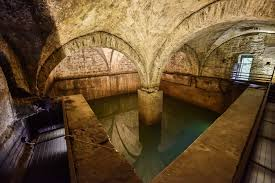
- The Lantro Fountain and Cistern Complex One of the most atmospheric places to experience this water history lies tucked beside the Church of San Lorenzo. This thousand-year-old underground reservoir, supported by stone columns like a miniature basilica of water, represents the pinnacle of medieval hydraulic engineering in Bergamo.
Bergamo Sotterranea (Underground Bergamo) Beyond the cisterns, extensive tunnel networks run beneath the Venetian Walls and old churches. These underground passages served not just for water storage and distribution, but also for defense and refuge.
These underground passages served multiple purposes:
- Water storage and distribution through interconnected cisterns
- Defense systems allowing movement during sieges
- Refuge spaces for civilians during conflicts
- Strategic supply routes connecting different parts of the city
In the crypts of Santa Maria Maggiore and tunnels under the bastions, you can sense how closely water and survival were bound together in this hilltop fortress city.
 The Fountain Era

- The Contarini Fountain (1780) In the heart of Piazza Vecchia stands this elegant octagonal marble masterpiece, donated by Podestà Alvise Contarini in 1780. Far more than decoration, this fountain historically served as a vital public water point and still functions today—a beautiful reminder of how water systems and civic life intertwined during Venetian rule. The fountain represents the Renaissance ideal of combining utility with beauty, transforming a practical necessity into architectural art that enhanced the city’s social and cultural life.
- The Fountain of St. Agatha This humble 13th-century stone fountain still burbles with water carried by the same systems the Romans began. Tucked away near the more famous Piazza Vecchia fountain, it represents the continuity of Bergamo’s water heritage—medieval engineering building directly upon ancient foundations.
- The Washhouses (Lavatoio): Water wasn’t just for drinking—it was for living, and nowhere is this clearer than at the old washhouses. On Via Mario Lupo in Città Alta, you can still see the stone basins where women gathered to scrub their laundry and swap neighborhood news. The water spouts, installed in 1891 but following much older patterns, tell the story of how an entire community depended on that precious trickle from the hills.
The preserved elements show us how 19th-century improvements built upon centuries-old water distribution systems, maintaining community traditions while improving efficiency and hygiene.
Your Water Trail Through Bergamo

Start Underground: Join a Bergamo Sotterranea tour to explore the Lantro Cistern and tunnel networks. These tours run seasonally and offer a cool escape in summer.
Follow the Ancient Path: Walk the Sentiero dei Vasi (Trail 912) starting from Via Ramera. This short, green walk follows the remains of the Roman Castagneta aqueduct, with springs you can still drink from.
Fountain Hopping in Città Alta:
- Begin at the 1780 octagonal marble Contarini Fountain in Piazza Vecchia
- Find the quiet 13th century stone Fountain of St. Agatha nearby
- Visit the old washhouse on Via Mario Lupo to see the 1891 spouts still refresh visitors today.
Look for Hidden Traces: As you wander Città Alta’s cobblestone streets, watch for old stone channels, drainage systems, and small fountains built into building walls—these often follow ancient water routes.
Why Bergamo’s Water Story Matters
What makes Bergamo’s water heritage extraordinary is how these ancient systems remain woven into the fabric of daily life. This isn’t just archaeology—it’s a parallel city you can walk, touch, and even drink from. Above ground, sunlight glints off marble fountains where locals still gather. Below, cisterns and tunnels breathe with centuries of damp history. The same springs that sustained Orobii settlements, Roman soldiers, medieval townspeople, and Renaissance citizens continue flowing today.
The Continuous Story
Each generation built upon the last:
- Orobii ingenuity in tapping hillside springs
- Roman engineering creating the aqueduct backbone
- Medieval innovation developing underground storage and distribution
- Renaissance refinement combining beauty with utility
- Modern preservation maintaining historic function today
When you trace Bergamo’s water story, you’re tracing the city itself: a hill town that always knew how to make the mountains run in its favor. Every sip from an active spring connects you to Roman legions. Every step through the Lantro Cistern echoes with medieval footsteps. Every pause at the Contarini Fountain links you to centuries of civic life.
This isn’t just sightseeing—it’s time travel through engineering genius. From the ingenious Orobii to Roman ambition to medieval survival to Renaissance beauty, Bergamo’s water heritage tells the complete story of human adaptation, innovation, and community.
Next time you pause at the Contarini Fountain in Piazza Vecchia, remember that you’re not just admiring a beautiful centerpiece. You’re witnessing the endpoint of a three-thousand-year journey — you’re witnessing the endpoint of a three-thousand-year journey that began in mountain springs and Roman ambition, flowing through medieval innovation to reach you today.
Follow the water, and discover Bergamo’s soul.